

If you’re planning restaurant interior design on a budget, you don’t have to choose between looking professional and staying within your price. Whether you’re setting up a cloud kitchen or a restaurant, the right layout and material choices can do far more for your business than expensive decor.
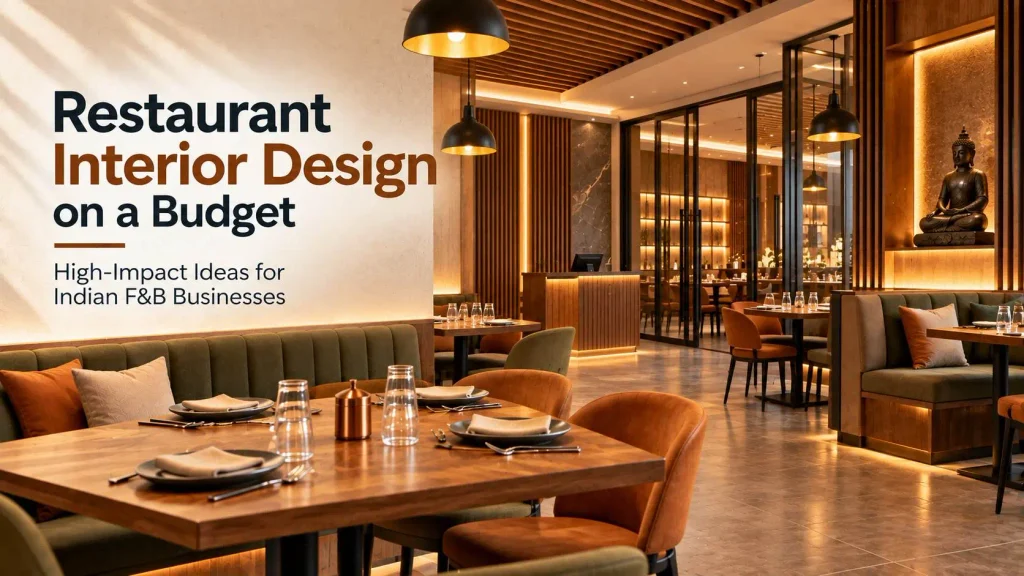
In India’s fast-growing F&B space, interiors are no longer just about aesthetics. They directly affect how customers move, how staff work, and how efficiently your kitchen runs. Here’s how to get real impact without overspending.
Start With the Layout, Not the Decor
Before picking finishes or furniture, map out how people actually move through your space—customers, staff, and orders. A good layout considers seating flow, kitchen access, billing counters, and service paths. Getting this right reduces bottlenecks during peak hours and often matters more to your bottom line than any wall finish.
Design an Efficient Counter
For QSRs, cafes, and cloud kitchens with a takeaway front, the counter is where customer experience and operations meet. A well-planned counter separates ordering, billing, pickup, and display into clear zones, so staff isn’t working over each other, and customers aren’t confused about where to stand. This is one of the highest-impact, lowest-cost changes you can make.
Use Lighting to Create Zones
Lighting is one of the most affordable ways to transform a restaurant without touching the layout. Instead of uniform lighting everywhere, create distinct zones like a warmer, softer glow near the entrance and dining area, brighter task lighting at the counter and display sections, and functional lighting in the kitchen. Layered lighting like this makes a small space feel intentional rather than empty.
How to Choose Materials for Commercial Kitchen Interiors
Material choice in a commercial kitchen isn’t just about looks—it’s about durability, hygiene, and ease of cleaning. Aluminum and glass are useful where visibility, light, and a clean look matter, such as display counters, partitions, and front-of-house areas. Stainless steel remains essential for cooking and prep zones because of the heat resistance and hygiene standards. The smartest approach is to use the right material for the right zone, rather than picking one material for the whole kitchen.
Make Small Restaurants Feel Bigger
Many standalone restaurants in India work with limited square footage. Mirrors, glass partitions, and lighter finishes can visually open up a compact space without any structural changes. Combined with efficient furniture choices, this creates a sense of openness that customers notice immediately.
Cloud Kitchen Interiors: Prioritize Workflow
Cloud kitchens don’t need a dining area, but they do need a tight operational flow. From receiving and storage to preparation, cooking, packing, and dispatch. Every square foot should support this sequence. A cloud kitchen designed around workflow, rather than appearance, will consistently outperform one designed only to look good in photos.
QSR Interiors: Design for Speed
For quick-service restaurant chains, speed is the interior’s real job. This means clear counter visibility, a queue path that doesn’t cross staff movement, easy-to-read menu displays, and a pickup zone that doesn’t create congestion. Small design decisions here directly affect how many customers you can serve per hour.
Where to Spend and Where to Save
A budget-friendly interior doesn’t mean cutting costs everywhere equally. Spend where it affects daily operations — counters, lighting, kitchen materials, and high-traffic areas. Save on purely decorative elements that don’t influence workflow or durability. This approach keeps your budget meaningful without compromising function.
Build an Interior That Can Grow With the Business
If you’re planning to scale — whether through more outlets, a shift to cloud kitchen operations, or adding dine-in to a takeaway model — design your first space with some flexibility in mind. A layout and material palette that can adapt saves you from a full redesign later.
Final Thoughts
Good restaurant interior design on a budget comes down to prioritizing what actually affects your operations: layout, counter efficiency, lighting zones, and the right materials for the right areas. Whether you’re running a cloud kitchen, a QSR, or a standalone restaurant, these choices create a space that works as hard as your team does — without unnecessary spending.