

If you’ve recently started planning your home interiors and confused with matte vs glossy interior? Whether it’s a new flat in Hyderabad, a villa in Bengaluru, or a 2BHK renovation in Mumbai – you’ve probably had this exact conversation with your interior designer:
It sounds like a small decision. But the finish you pick for your kitchen shutters, wardrobe panels, walls, and furniture actually shapes how your entire home feels – every single day.
So let’s break it down properly. No generic comparisons. Just a practical guide based on how Indian homes actually look, live, and function.
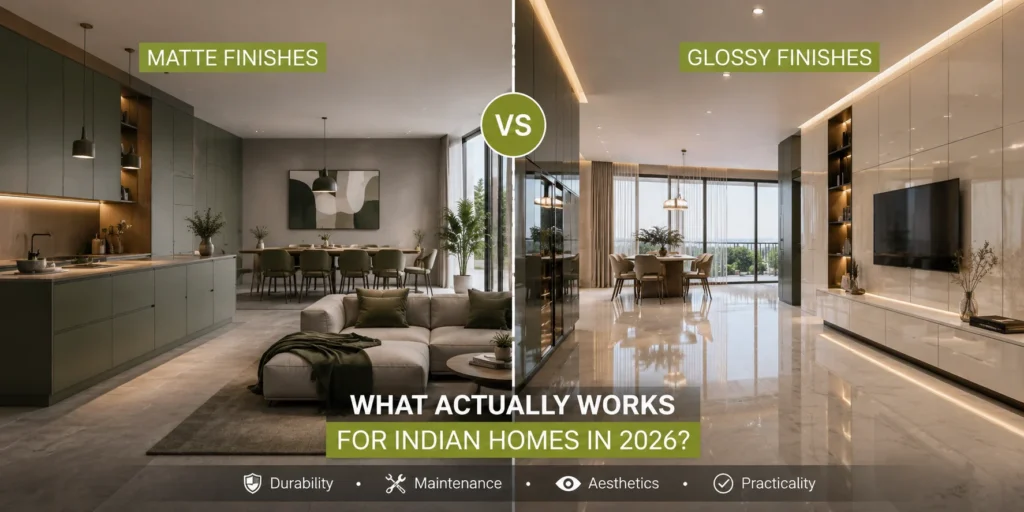
First, What’s the Real Difference Between Matte and Glossy?
A matte finish absorbs light. It doesn’t reflect. The result is a soft, velvety texture that feels calm and understated. Run your hand over a matte laminate shutter – it feels almost suede-like.
A glossy finish reflects light. It bounces brightness around the room and creates a polished, sharp appearance. High-gloss kitchen cabinets catch the light and give your space that “showroom” feel.
Point: Both are widely used in Indian homes. The question is when to use which, and that’s where most people go wrong by treating it as an option or decision.
Why Matte Finishes Are Leading Interior Trends in India Right Now
There’s a clear shift happening in urban Indian homeowners. They are thinking about their spaces. The obsession with shiny, high-gloss everything that dominated the 2010s is fading.
What’s replacing this is the interiors that feel warm, grounded, and genuinely comfortable to live in. And here’s why matte finishes are winning in 2026:
1. They Look Expensive Without Trying Too Hard
- There’s something about a matte surface – A dark matte grey kitchen or a warm beige matte wardrobe finish gives you that designer-showroom look without the “too much” feeling.
- This is why luxury apartment projects across cities like Pune, Chennai, and Gurugram are almost universally specifying matte laminates for their modular interiors. The aesthetic is clean, intentional, and premium.
2. Practical for Indian Family Life
- Indian homes are active. There are kids, frequent cooking, guests, and daily use of surfaces takes a beating.
- Every fingerprint, every smudge, every water splash shows immediately. Matte finishes are far more forgiving. Light marks, minor scratches, and everyday smudges blend in and don’t demand your attention.
You don’t have to wipe down your kitchen every time someone opens a drawer!
3. They Work With India’s Design Moment
- The dominant interior themes in Indian homes right now – earthy palettes, Japanese-inspired minimalism, warm neutral tones, wood and stone textures – all pair naturally with matte finishes.
4. Matte Interiors Feel Calmer
- This is harder to quantify but very real. If you’ve ever walked into a home with matte walls, matte cabinetry, and soft lighting, it feels different. Quieter. More relaxing.
- After a long day, the last thing you want is your home bouncing light at you from every surface. Matte finishes absorb that energy. They make a home feel like a place to decompress.
Where Glossy Finishes Still Make Perfect Sense
Glossy finishes haven’t gone anywhere – they’re just being used more strategically now. And in the right context, they’re genuinely the better choice.
Small Kitchens and Compact Apartments
- If your kitchen is tight – say under 80 sq ft – glossy cabinet shutters will visually open it up. The light reflection tricks the eye into reading the space as larger and brighter.
- This is especially useful in older constructions where kitchen sizes are small and natural light is limited.
Bathrooms
- Glossy tiles remain the standard for bathrooms, and for good reason. They’re easy to clean.
- They reflect light well in windowless spaces, and they hold up against moisture far better than most matte alternatives.
Rooms That Get Less Natural Light
- North-facing rooms, interiors on lower floors, or spaces where windows are limited, glossy surfaces help by amplifying whatever light is available.
- In these situations, a matte-everything approach can make a room feel dull and heavy.
When You Want a Dramatic Focal Point
- A single glossy acrylic panel on a TV unit, a high-gloss countertop against matte lower cabinets, and a glossy lacquered finish on one accent wall.
- These work beautifully as contrast elements. The trick is using gloss deliberately, not wall-to-wall.
Room-by-Room Guide: Which Finish to Choose
Kitchen
The matte finish modular kitchen is the dominant trend in India right now, and with good reason. Dark matte finishes – charcoal, slate grey, deep navy, forest green – are particularly popular in larger kitchens with good lighting.
That said, if your kitchen is compact or poorly lit, consider glossy shutters for upper cabinets and matte for lower ones. You get the brightening effect where it matters without the full fingerprint-magnet problem.
Best picks: Matte laminate shutters, matte acrylic for premium kitchens, matte PU finish for budget-conscious builds.
Wardrobe and Bedroom
Matte wins clearly here. Matte laminate wardrobes – especially in warm tones like greige, taupe, warm white, or muted wood grain — create a bedroom that feels relaxing and considered.
Glossy wardrobes tend to dominate visually and can make a bedroom feel like a showroom rather than a restful space.
Best picks: Matte laminate with recessed handles, textured matte finishes, matte wood-grain laminates.
Living Room
For your TV unit, console, and accent cabinetry, a matte finish almost always works better in 2026. It ties in cleanly with textured walls, fluted panels, and the kind of layered material combinations that define modern Indian living rooms.
If you want a glossy accent – a lacquered shelf back panel, a high-gloss vase or decorative piece – that’s the place for it.
Walls
Matte wall paints are significantly better for most rooms. They hide surface imperfections, are easier to touch up, and don’t create distracting glare.
The exception is kitchens and areas near sinks where washability matters – a satin or semi-gloss paint makes practical sense there.
Bathroom
Glossy tiles, full stop. In a bathroom context, glossy ceramic or vitrified tiles are low-maintenance, moisture-resistant, and work with most lighting conditions.
Quick Comparison: Matte vs Glossy at a Glance
| Matte Finish | Glossy Finish | |
| Appearance | Soft, warm, sophisticated | Bright, reflective, sharp |
| Fingerprints & Smudges | Hides well | Shows immediately |
| Cleaning | Slightly more effort for stains | Easy wipe-down |
| Small Rooms | Can feel compact | Opens up the space |
| Natural Light Rooms | Works beautifully | Can feel too bright |
| Design Trend 2026 | Strongly trending | Still relevant in select spaces |
| Best For | Bedrooms, living rooms, and large kitchens | Bathrooms, compact kitchens, low-light rooms |
The Approach Most Interior Designers Actually Recommend
The honest answer? Don’t go all-in on either. The most well-designed homes, InteriorChoose works on using finishes with intention.
It’s not a default mix — it’s a considered one.
Some combinations that work very well in Indian homes:
Matte kitchen shutters + glossy backsplash tiles — the tile reflects light at eye level without the maintenance problem on cabinet doors
Matte wardrobes + glossy flooring — vitrified tiles or polished marble underfoot brightens the room while keeping the furniture calm
Matte walls + gloss accents in décor — lacquered vases, glossy cushion covers, polished metal hardware
Matte TV unit + glossy fluted panel back — a popular combination in living rooms right now
The goal is contrast and balance — not uniformity.
What’s Driving Interior Finish Trends in India in 2026?
A few things are shaping how people are choosing finishes today:
The post-pandemic home shift — People spent more time at home and realised they wanted their spaces to feel like sanctuaries, not showrooms. That’s pushed calm, matte-heavy palettes into the mainstream.
Influence of international design — Japandi, Wabi-sabi, and Scandinavian aesthetics — all of which favour matte, textured, organic surfaces — have found a strong audience among urban Indian homeowners.
Material awareness — People are paying closer attention to how materials age. Matte finishes tend to hold up visually better over time. A scratched glossy surface looks obviously damaged; a scratched matte surface is often barely noticeable.
Sustainable choices — Earthy, matte, nature-inspired interiors feel more aligned with conscious living. It’s a soft factor, but it does influence decisions.
How interiorchoose helps you
There’s no universally correct answer between matte and glossy. But in 2026, the design conversation in India has clearly shifted toward matte as the default — with gloss used purposefully in the right spaces.
If you’re designing a new home or renovating, the better question to ask isn’t “matte ya glossy?” — it’s “where does each finish work best in my specific space?”
That’s where working with a team that understands both the trends and the practical realities of Indian homes makes a real difference.
At InteriorChoose, we help you make final decisions that actually work for your home — not just what looks good in a catalogue. From modular kitchens and wardrobes to complete home interiors, every finish we specify is chosen for your space, your light, and how you actually live.
Looking to design your home interiors? Explore our modular interior solutions at InteriorChoose.com